Unlike LLM-based security tools that send your data to external APIs, Polygraf runs specialized SLMs entirely on your infrastructure — delivering enterprise-grade accuracy with zero data exposure.
Every model runs locally on your hardware. No data is ever transmitted to external services. Fully air-gap compatible.
0 bytes sent externally
Specialized models are orders of magnitude smaller and faster than general-purpose LLMs. Users experience zero friction.
<100ms average
Each SLM is purpose-trained for a specific security task — PII detection, AI provenance, credential scanning — with higher accuracy than generalist models.
93–99% accuracy
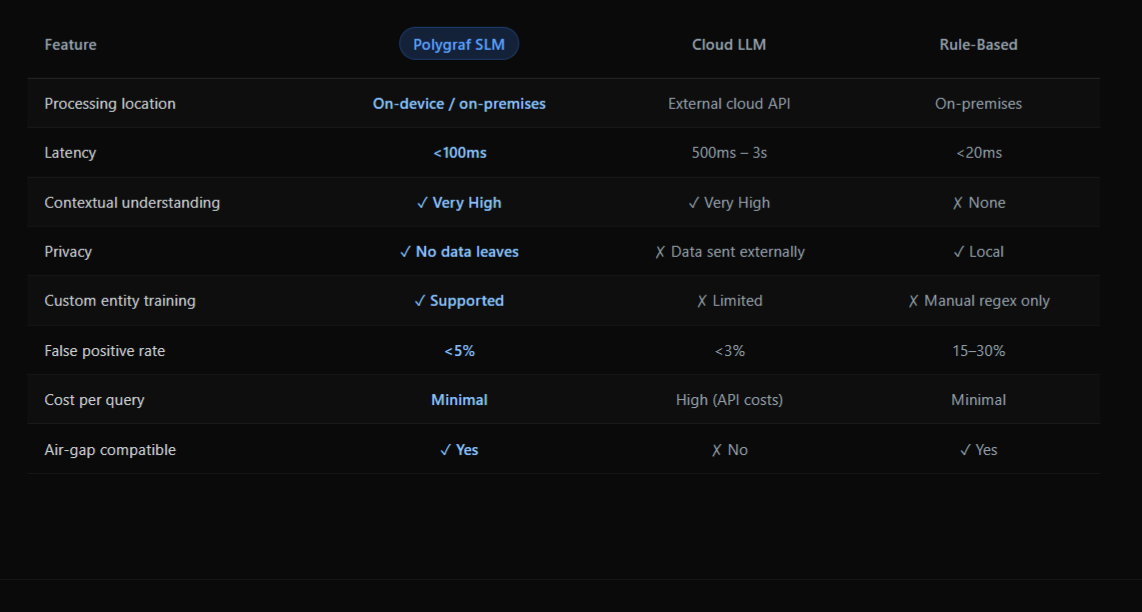
Comparison
Based on internal benchmarking across standard enterprise workloads. LLM latency figures from published API documentation. Rule-based false positive rates from industry research (Gartner, 2023).
The Reality
of employees use AI tools not approved by IT
AI queries contains sensitive data — PII, credentials, or IP
traditional DLP tools were built to handle LLM interactions
Detection accuracy
across all entity types
Max latency
imperceptible to users
Entity types
PII, PHI, credentials, IP
On-premises
PII, PHI, credentials, IP
Out-of-the-box detection across every sensitive data category — plus custom entity training for your organization's unique identifiers.
Personal Identity
Contextual & Misc
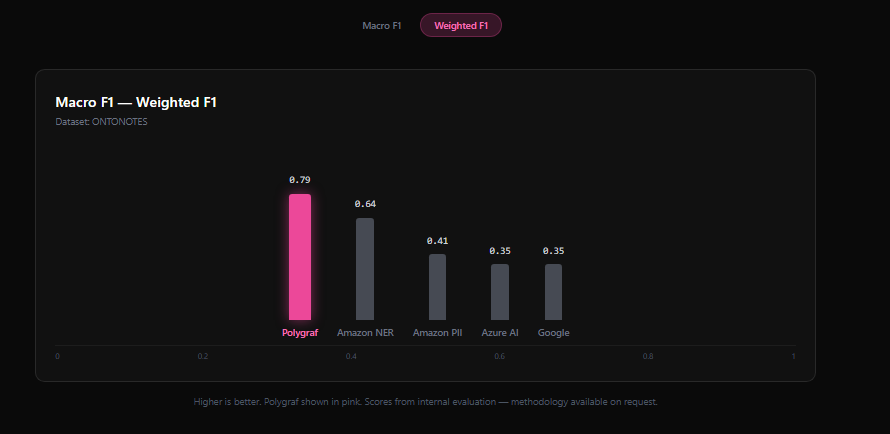
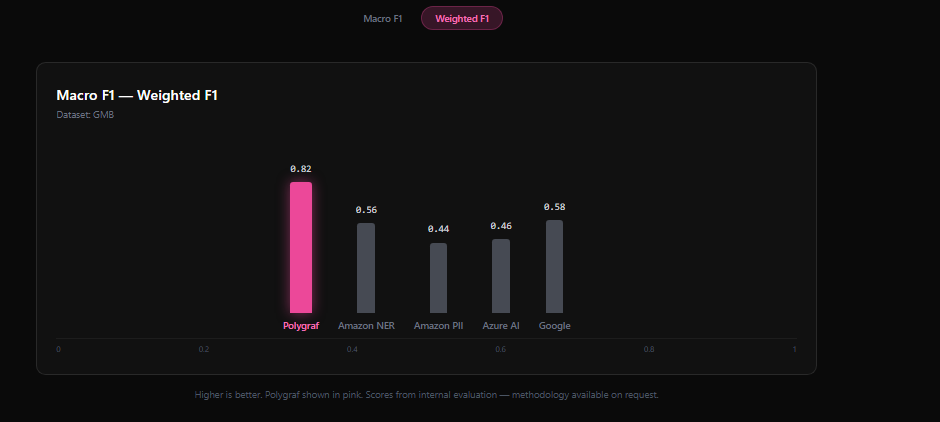
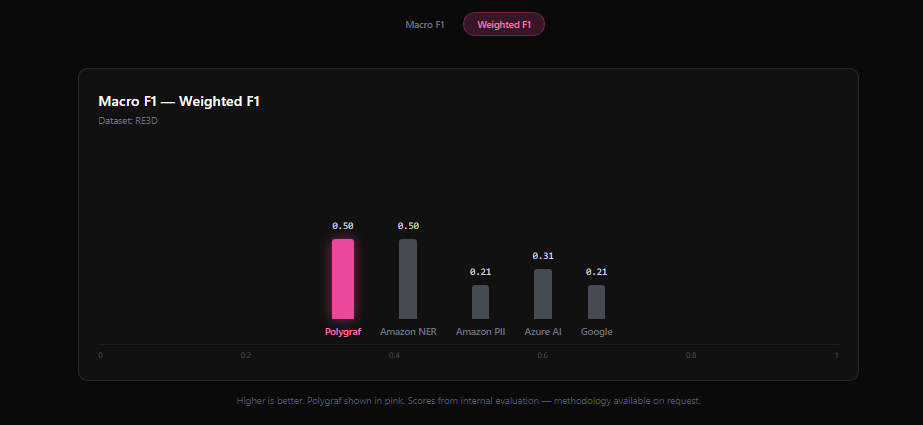
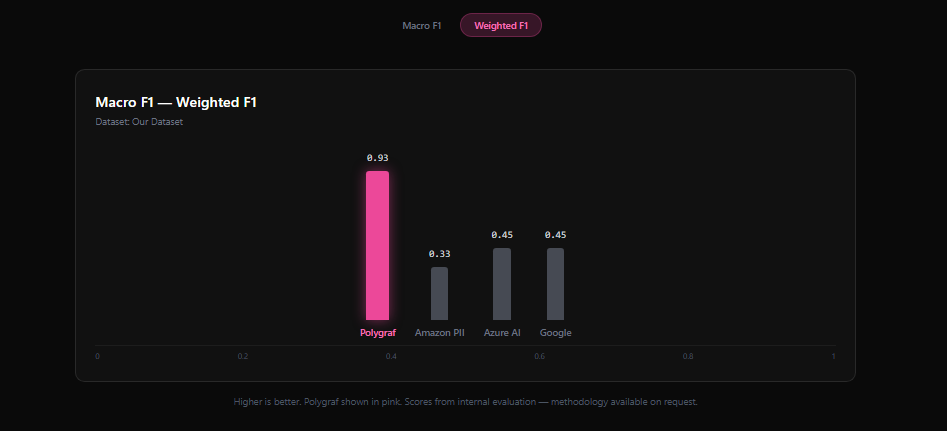
Macro F1 and Weighted F1 scores across industry-standard NER datasets. Polygraf consistently outperforms cloud-based competitors — while keeping all data on-premises.
An SLM is a neural network model with tens to hundreds of millions of parameters — purpose-trained for a narrow task. Unlike general-purpose LLMs (which have billions of parameters and broad capabilities), Polygraf’s SLMs are each trained on a specific security task like PII detection or credential scanning. This makes them much faster, cheaper to run, and more accurate for that specific task.
For the specific task of sensitive data detection, our SLMs outperform general-purpose LLMs on every standard benchmark (ONTONOTES, GMB, RE3D, and our proprietary dataset). GPT-4 and Claude are excellent at broad reasoning, but they were not designed for this task and carry significantly higher false-positive and false-negative rates.
Yes. Polygraf supports custom entity training. You provide labeled examples of your organization-specific identifiers (e.g. internal project codes, employee IDs, proprietary product names), and we fine-tune a dedicated SLM for your environment.
Most organizations run Polygraf on standard enterprise server hardware. A recommended baseline is a 16-core CPU server with 64GB RAM. GPU acceleration is supported but not required. Models are quantized for efficient inference.
Macro F1 averages the F1 score across all entity classes equally, regardless of class size — it’s a more stringent measure of broad coverage. Weighted F1 weights each class by its frequency in the dataset. Both are standard NLP evaluation metrics. We report both for full transparency.
The benchmarks shown are from our internal evaluation lab using publicly available datasets (ONTONOTES, GMB, RE3D). We are in the process of engaging a third-party auditor for independent verification. Full methodology and evaluation scripts are available under NDA.
Deep dive into SLM architecture, benchmarks, and deployment specs




© 2026 Polygraf AI. All rights reserved.
Your download will start now.
Please provide information below and we will send you a link to download the white paper.
 Data Privacy
  Data Provenance
  Content Generation